




How to Prepare for a Trek
How to prepare for a trek?
- Trek
How to organize for a trek?
A bit on how to give parents peace of mind
Topics I will cover in the article:
General safety on treks Preparation for a trek Safety conduct during the trek - environmental hazards and medical advice (the author is not a doctor).
Planning a trek independently
Choosing gear for the trek and the big trip as a whole
General safety -
Preparation for a trek
When setting out on a trek you take a certain calculated risk that things might happen to you along the way...
But the risk is small and calculated only if you know that in case you need help, there will be someone to give it to you!
The goal is to create several "plan Bs" that if something happens to you, you can rely on them.
1. Let people know where and when you are going
Send parents a message or email with a description of the trek, its location (even a point or route on google maps), how many days you are supposed to go for, and with whom.
*Not so they can show off to friends, but so that someone notices if you return on time
If you don't have the option to send an email or message, inform someone local. (The owner of the hostel you stayed at / a friend traveling in the same area as you who isn't going on the trek at the same time / a travel agency or any person you trust who will ask themselves the question - if I haven't heard from them by now, maybe I should report to someone. It is recommended to leave your details and contact details for reporting with them)
2. Take numbers of authorities or organizations that can assist you
In many countries and continents there is an emergency number you can contact to request help or rescue
Numbers of travel agencies that will reach out to the relevant authorities if you contact them
Hostel owners In short - whoever applies to the previous item applies to this item too
3. Know where you are going and be self-reliant
< >It is advisable to take a physical map of the area where you are doing the trek with you - it never runs out of battery. Download navigation apps that work offline and the relevant maps (good apps - maps.me, google maps, and soviet military map - for the navigators among us). Maps.me, for example, shows you exactly the trail, where you are relative to it, and how to get to your destination - like waze but for pedestrians. Yes, even in the middle of nowhere. Note that you need to download the maps to the app before you disconnect from wifi.. Ask locals if you are not sure where the trail is and how long it takes to arrive - almost always they are right! And if they say that what you are planning is not worth it, then it's worth reconsidering or seeking more advice. Always think about where there will be people who can give you help - other guides / a local village or the nearest city.
4. Make sure you have ways to get in touch if needed
< >Buy a local SIM if possible and check with the locals if there is reception along the route (you can't always rely on it). If you know there won't be reception or aren't sure about it - you can rent a satellite communication device in Israel - easy to operate and connects to a smartphone (search for inreach, for example). Sure you can also abroad, it's just a matter of hassle and money..
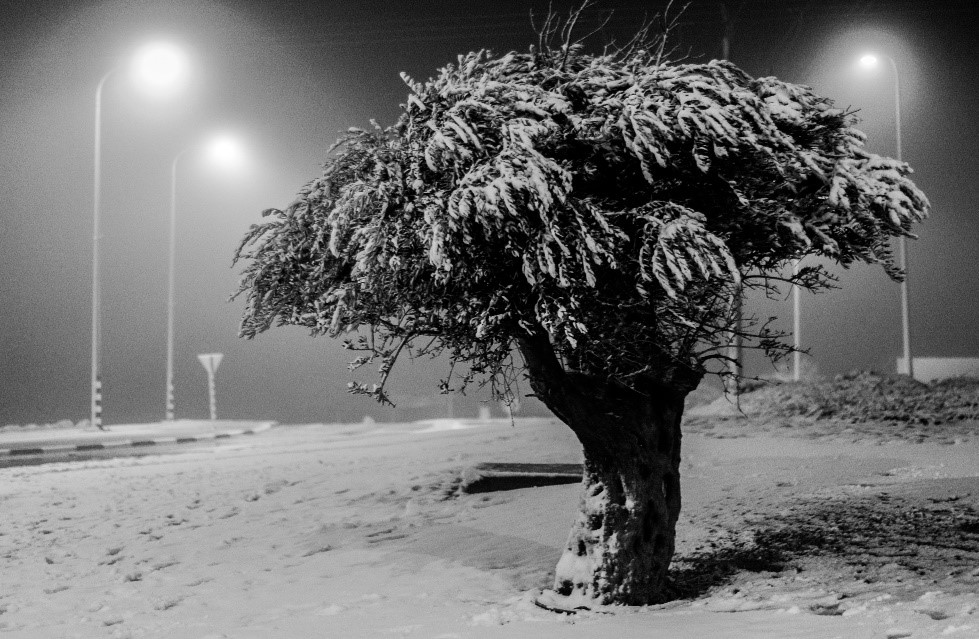
Snow in Mitzpe Ramon - Israel has views that are no less beautiful!
Safety conduct during the trek
Environmental hazards and medical advice (the writer is a medic and not a doctor)
It is difficult to cover everything because the dangers depend on the environment in which you travel and every environment is very diverse; in this chapter I will try to open your mind a bit to - what could be dangerous in my environment?
This is basically the question that should guide you - and that way you will probably also prevent most dangers in advance.
Animals
Extreme temperatures
Altitudes (with an emphasis on ascending above 3000 meters)
Terrain I will try to touch a bit on each section, but you can continue the thought process yourself.
Animals - you are in another country, maybe even on another continent.. Have you asked yourselves if you know the animals that exist here? Because frankly, you are in their home and you will probably meet them (at least I hope so for you)
So animals can be venomous/predatory/protective or dangerous in a million ways, and response guidelines vary drastically from animal to animal, even between those that look identical to us,
For example - guidelines for action in case of a grizzly bear (brown bear) attack are to retreat carefully if possible, and if not, lie on your stomach and play dead. And prevent the bear from turning you over by spreading your legs
In contrast, in the case of a black bear attack, you must fight back!
In any case, if you travel in an area where there is a likelihood of meeting bears, it is desirable to travel with a bell / some noisemaker so the bear hears you approaching and isn't surprised. If you suffer from that annoying bell like me, you can sing songs to the bear or tell it stories.. I like singing to it about "The Bare Necessities" most
The bottom line is that you need to know which animals you might encounter and what the correct guidelines are to minimize the danger.
Extreme temperatures -
Prolonged or improper exposure to extreme temperatures (the extremity of the temperature is relative.. even 12 degrees is pretty extreme if you only have short clothes) can be very dangerous
Hypothermia: In Hebrew - sub-heat. A drop in body temperature due to exposure to excessively low temperatures over time. Hypothermia can manifest in confusion and apathy, clouding of senses, and uncontrollable shivering, and of course you guessed right - low temperature. How low? Normal body temperature is above 36 degrees and below 38; 34 is too low. 32 is really dangerous, like really really. What to do? If the victim's clothes are wet, remove them and wrap in dry, warm layers. Do not let the victim touch hot things; it can create a skin burn - they don't feel the heat like you right now and aren't able to be careful.
Dehydration: Dehydration is simply a state where you don't have enough water in your body and blood. You simply didn't drink enough; it can very well happen in cold weather too, it's just that in Israel we don't know what that is... (cold) It will usually manifest in dizziness, nausea, and headaches. In a stage of more severe dehydration also in vomiting - simply because less blood flows to the stomach (because what's important now is not digesting food) so that enough blood flows to the brain and heart. Sometimes there will also be a tingling sensation in the hands or feet. A good method to know if you are dehydrated - when was the last time you went to pee? More than an hour or two? Then you are dehydrated. But assume that when you are in strenuous physical activity like a trek, you are always at least a little dehydrated. Just drink water every few minutes.
Heat stroke: in Hebrew – Zefta Shemesh! When body temperature rises dramatically. (Extreme - 39-42 degrees, 42 is life-threatening) It can happen simply from prolonged exposure to too high a temperature with too little ability for the body to cool itself. That's it. What's dangerous about it? That your brain (which is also composed of proteins) will turn into a hard-boiled egg. Plain and simple. What's even more dangerous? Have you ever seen a hard-boiled egg turn back into a raw egg? Great, you get it. A heat stroke victim may exhibit apathy, confusion, and clouding of consciousness (remember?) and sometimes even reach actual fainting. What to do? Drag to a shaded place or create shade - stop sun exposure. Remove clothes from the victim (within reason) and pour lots and lots of water on them - some would say 40 liters, mainly on the chest area. Do NOT pour on the head!!!! Heat stroke can also happen if you engage in overly strenuous activity with thermal clothing, for example - which doesn't allow the body to cool itself.. Everything written here is by no means a substitute for consulting a doctor, calling for medical assistance, or rescue.
Ascending to high altitudes - as a rule - human beings are not meant to live at significant altitudes. Why? Because at high altitude oxygen is thinner, and at the point where it's too thin, the cells inside you start to die.
On altitudes and symptoms - it's always advisable to gain altitude in "steps" to allow the body to acclimatize; anyone who scuba dives will understand it's the same logic. The steps should preferably not be more than 800 meters in a single push, meaning don't ascend 1100 meters at once without giving the body at least one extra day (in which you don't gain any altitude) to acclimatize. Want to ascend less? Even better.
What is considered an altitude that requires acclimatization? Generally speaking, we'll define that anything above 3000 meters is an altitude requiring acclimatization.. At first, you might be able to take steps of more than an 800-meter ascent, and as you go higher you'll see that the steps get smaller..
Stages - you will feel a significant difference when you cross 3000-something (entering the acclimatization range)
Another difference around 4000 (and usually trees will start to disappear - yes, it's hard for them too)
Another difference will be around 4500
And a fourth difference will be 5000-5200 - here you will really feel difficulty supplying yourselves with oxygen.
The higher you go, the harder acclimatization will be
Symptoms - there are lots of possible symptoms, so I won't mention everything...
You might have nosebleeds, a feeling of pressure in the ears, difficulty sleeping (up to insomnia), nausea, and more. It's highly recommended to read extensively about it.
What to do? Descend in altitude, as much as possible, and call for medical help. If you have pills to treat altitude sickness, you can take them under a doctor's advance guidance
Some people take altitude sickness pills at a lower dosage during the ascent as a sort of prevention..
Pills sometimes have weird side effects, so not everyone likes them.. For me, for example, I had tingling sensations ("ants") at a fixed time of day and almost always in my left leg above the knee... just so you know..
Terrain features -
This is perhaps the most general topic here... but come on, we're at the end..
Try thinking about Israel: what would you say to a tourist heading out in winter on a rainy day to the desert or the streams above the Dead Sea?
No, taking an umbrella is not the answer; be extremely careful of flash floods.
So that, for instance, is a danger of the terrain, and the nature of the terrain..
So again, there's the whole thing about you not knowing the place you are going to, and all...
Maybe these are mountains where water created hollows inside them, so you're actually walking on the crust of a cave and there's a risk of collapsing inward? Maybe you're on an epic road trip in Namibia and got stuck in the middle of the sand with no tools to get out or as a single vehicle?
So that's the point - there are endless possibilities.. Try to read, think about what's possible - no need to invent illogical things.. Flash floods exist outside Israel too.. or avalanches.. Do you know, for example, what an avalanche sounds like or what to do in such a case? Me neither.. but I'm sure I'll know more if I Google it.
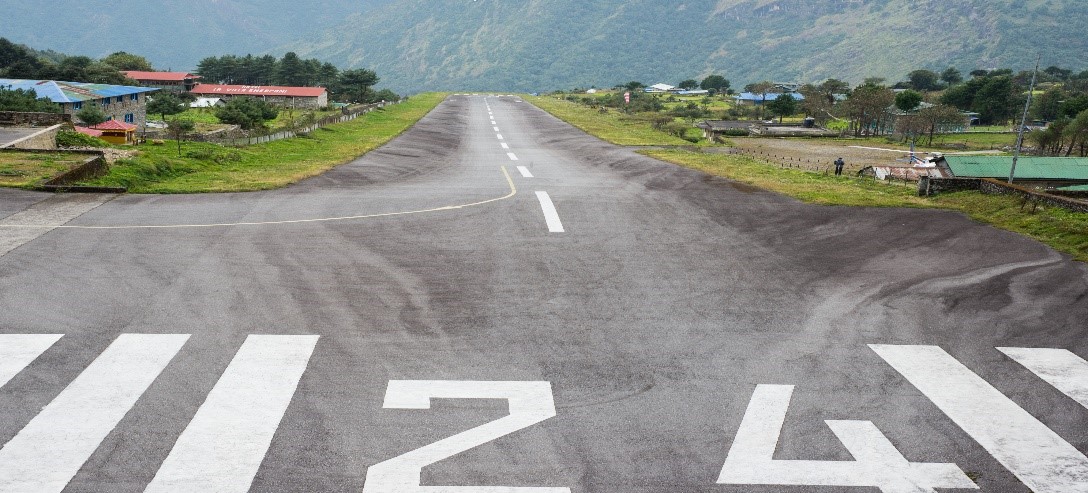
The runway in Lukla, Nepal
Planning a trek independently
For those who have experience and an adventurous spirit
Planning a trek independently has a few steps
Choosing the region where the trek will take place
Gathering relevant information about this region - trails, guest huts, etc.
Route planning
Makes sense, right? Yes. So here are a few tips for each step -
Choosing a region -
Ask locals / guesthouse owners where you're staying about national parks you can hike in or mountains you can hike in; many times there are places that aren't popular or touristy, but locals know them very well
Open Google Maps, switch to topography (a map showing elevations) and satellite imagery (yes, open 2 web pages) and look at the mountains and national parks visible in the country.. look at available photos and even Street View.. many times you can see if trails are marked leading somewhere and understand if it's really an established reserve..
Google in English whatever you found (sometimes Hebrew helps too) and the main names, and start diving in..
Searching for information
So regarding trails we've touched on that, Google in English we've mentioned, but maps - go into your navigation apps and look for the trails.. you can even set a dummy origin and destination and see if Maps.me finds a trail..
Unlike in Israel, in many countries there are no maps in bookstores; it's worth a try, but usually travel agencies are the address or tourist information. I was charged twice as much for a map at the tourist info compared to what I found later in the local market.. presumably if I wasn't too shy to ask I would have found it easily and cheaply.
Many times maps and all the info are at the entrance to the reserve, just like in Israel; there's a booth like that with info leaflets and maps for sale.. it's a great time to ask everything. But E-V-E-R-Y-T-H-I-N-G - where there are huts, what's in them, how long it takes from place to place, whether you can drink the water, where there's water to refill, whether there are bears, etc. etc.. worst-case scenario they'll tell you - we don't know..
Route planning
Try to think where you start and in which place you can finish so you have good access to hitchhiking/public transportation
Remember - really fast walking is 6 km/h (if you're the drill sergeant from basic training and also around 1.95 meters, then maybe 8 km/h). Most of us walk on flat ground at 4 km/h and on uphills and downhills less than that (at high altitude like 5000 plus you might reach a pace of 1 km/h and less). It's also worth remembering that you walk faster when you're alone.
Plan where you want to stop each day, you can give yourselves a few options and decide based on your pace
Study the layout of the terrain along the route based on topography; you don't have a guide - this is your guide for where you are on the route.. (based on topography you can also estimate what your pace will be in a specific section)
*Reminders - you consume at least 3 liters of drinking water a day. To this calculation, add water for cooking, brushing teeth, etc. If you drink less than 3 liters, that's not good.
Don't plan a walking day of more than 9-10 hours.. you need to take stops and breaks, and extra time is always better than arriving in the dark.
Equipment
Choosing the right gear doesn't necessarily mean buying what's best or most expensive, but rather buying the suitable gear, and especially the gear that is right for you!
Short tips-
Trekking poles- Yes. And preferably ones with a cork handle or covered in a pleasant fabric like that.. plain silicone/plastic is really gross and sticky on your hands after half a day
Waterproof compression sacks- Definitely yes (if there is even a slight chance of rain or water where you'll be). For dry clothes in the pack, for the sleeping bag, and for accessories or tracking devices, wallet, and phone. They come in various sizes and even some with a gore tex bottom where air comes out (but water doesn't enter because it's sealed).
This is wonderful.
Sleeping bag-
The most important thing in a sleeping bag is- that it fits your size! It sounds funny, but not all companies manufacture sleeping bags in the same lengths, and even between models from the same company there will be a difference.
And why is this so important? A sleeping bag doesn't heat, it creates insulation. What warms is your body, and if the sleeping bag is too long or too wide, your body won't manage to heat up the entire space, especially not the feet area, and that's a bummer.
There are all kinds of ways to deal with this if you already have a sleeping bag that isn't the right size, but if you're buying new gear, it's better if it fits, right?
Now you might ask- how long is too long? Well, this isn't absolute, but 10 centimeters or more is definitely too long. And the difference in every centimeter will become more extreme the lower the temperatures you sleep in.
This means that if you sleep in minus 10 degrees, the difference between 4 centimeters too long and 9 centimeters too long will be felt more extremely than if you sleep in 7 degrees.
What is the second most important thing when choosing a sleeping bag? That its temperature range matches the environment you are going to trek in. There is no reason to buy a sleeping bag that will warm you at minus 10 degrees if you're going to sleep in an environment where the nighttime temperature is plus 7. You will simply sweat all night, and from experience, that's not pleasant.
True, a trip is varied, and you can't buy 5 sleeping bags (whoever can, good for them)
And for this problem there are several possible solutions-
Buy a sleeping bag that fits the most extreme environment you'll trek in, so you'll be covered for all situations.
Buy a sleeping bag that fits 80% of situations and additionally buy a liner (like a sheet but shaped like a sleeping bag- wrapping you 360 degrees) that adds a bit more warmth retention. A liner can also be made of various materials, and there are those that add up to 10 degrees to the heat retention capacity of the combination of both. *Note- you sleep inside the liner with the liner inside the sleeping bag, in 2 layers.
Sleeping bags are divided according to several categories-
Temperature range
The fill material of the sleeping bag (which creates the insulation)
Shape
Shape- the 2 main shapes are
Mummy- a shape that contours more with the body's natural curves (for example- narrower at the feet and wider at the shoulders) thereby helping the body heat up the inner space of the sleeping bag. This shape typically characterizes sleeping bags intended for low temperatures.
Rectangular or semi-rectangular (rectangle/semirectangle) – a sleeping bag in a rectangle shape that doesn't change according to the body, or one that is semi-rectangular- a rectangle that changes a little, something between a rectangle and a mummy..
Fill material- there are 2 types of fill
Down- natural goose down/duck down (duck/goose) is simply real bird feathers. Why is it good? Because it's the lightest natural material that enables such high heat retention. Fur, for example, is very heavy even though it also retains heat excellently and even better than down. What are the advantages of natural down? Usually the weight will be much lower than that of a synthetic fiber sleeping bag. Heat retention capability is also usually higher and the material can compress into a smaller volume (and therefore the sleeping bag can also be compressed to a smaller size in the backpack). Disadvantages? Down is less resistant to humidity and moisture, and over time the feathers stick to each other and there are uneven parts in their filling, damaging heat retention capability. And down is expensive. In addition, down quality is measured in FP (fillpower), which is an index of density and quality in down. The higher the number, the higher quality and denser the down, giving you better heat retention capability at a lower weight. It is also worth checking the weight of the fill itself relative to the total weight- if you compare sleeping bags with identical or similar FP, one of them might have more material (down) out of the total weight.
Synthetic fibers- fibers manufactured in a laboratory. Advantages? The fibers are more resistant to humidity, moisture, and long-term wear. And it's cheap compared to down. Disadvantages? They are usually heavier, it's unlikely you'll find a sleeping bag intended for extreme temperatures (below minus 10 degrees) made from synthetic fibers, and if you do, it will probably be very heavy. *Note regarding natural down- some companies treat the feathers with a water-repellent treatment, but down will still be less resistant to moisture than synthetic fibers. In addition, there is a possibility that an animal suffered while alive to provide the feathers for your sleeping bag; this depends on the manufacturing company.
Temperature range- there are two standards for the temperatures written on the sleeping bag- American standard and European standard.
European standard- there are 3 values-
Comfort range (comfort) : refers to the temperature range in which a standard woman will not feel cold in a standard environment (wind/humidity etc. can affect the temperature actually felt versus the one measured)
Comfort range limit (comfort limit): refers to the comfort range in which a standard man will not feel cold in a standard environment. Note- there is a distinction between women and men because the physiology is different and women tend to feel colder.
Risk range (risk)- the range (up to the indicated minimum point) in which you can survive the night but will feel cold and even risk severe cold injuries as you get closer to the minimum temperature. Not recommended at all.
American standard- it's simple, they usually state only the limit of the comfort range. And they write degrees in Fahrenheit.. all written temperatures are the lower limit..
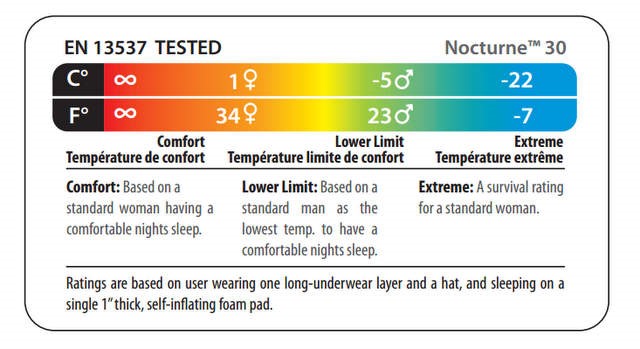
For example- in the photo you can see that 1 degree Celsius is the lower limit of the comfort range, marked with the sign for a woman, followed by the start of the comfort range for a man with a limit of minus 5
A few additional things about sleeping bags-
The material from which the sleeping bag shell is made varies from company to company, there are those that are more pleasant to touch and those less so, and those that are more moisture-resistant and those less so
There are several things that further help the sleeping bag retain heat, for example- a shoulder belt/collar (collar tube or any other version of the term) which basically creates a closure above the shoulders, thereby creating a barrier between what is below the shoulders down to the feet and above the shoulders to the head. The reason is that this is usually where the opening for head and neck is, and from there you lose the most heat.
There are many features for sleeping bags- like a unique footbox shape (because our feet stick out from the body. It's supposed to be more comfortable). Wind-resistant zippers, etc.. every reasonable+ company uses YKK zippers. A YKK zipper is a kind of insurance for reasonable to excellent quality; if it doesn't have them, it's probably not a good company. Again, not always. And this is also true for backpacks and anything with zippers, not just sleeping bags.
Storing and caring for a sleeping bag - every sleeping bag must be stored completely uncompressed! Compressing the sleeping bag destroys the elasticity of the fibers and filling!
Washing a sleeping bag needs to be done in a special way that can easily be found online.. Remember that if the sleeping bag has goose down filling, the feathers can stick together in the wash, which is why it's washed using a special method. Here there's an added advantage to a liner - it protects the sleeping bag from your sweat, etc.
So why do we compress it when going on a trek? Simple - so we have more room in the backpack. Therefore, every evening (if you missed one once every few days it's not terrible) you must unpack the sleeping bag and let it spend the night uncompressed (even if you're not sleeping in it).
**Don't sleep in the sleeping bag with dirty clothes. You both dirty it and they don't help you stay warm. In principle, it's best to sleep naked in the sleeping bag (this way the body emits the most heat into the bag's space), and also because it's simply gross to sleep in dirty clothes.
Backpack -
Like a sleeping bag, the most important thing is that the dimensions of the backpack fit you. I don't mean the volume the backpack holds, but its size/dimensions. Most backpacks from major brands have adjustable systems that can fit most people, but that doesn't necessarily mean the backpack will fit you; there are models designed for women's anatomy and those designed for men. You must try it on to know if a backpack fits you.
I won't elaborate on choosing the right backpack for you because it depends on multiple criteria of personal comfort,
but a few words on how to fit a backpack to the body -
The most important tip here - fasten the hip belt, and don't let it be loose.
It isn't designed just to keep the backpack from bouncing on your back; it's designed to take 70% or more of the weight you're carrying. Just like giving someone a piggyback ride - they hold themselves up by wrapping their legs around your waist! I've seen too many people who don't fasten this belt, and it's basically like walking with an oversized child hanging from your shoulders, swinging from side to side.
Shoes -
What's most important in shoes? Great, you've already got the idea...
Shoes that aren't your size can cause blisters and chafing if they're too small, or ankle sprains, etc., if they're too big, because they simply don't support the foot..
So try them on.. Shoes should wrap around your foot.. really hug and stabilize it.
There are many shoe brands and everyone needs to find what's comfortable for them, but a few principles for choosing shoes are -
Categorizing shoes by material -
Leather - Leather is a super flexible and strong material (from your personal experience), very durable, waterproof, and allows ventilation (so-called "breathable"). But it needs care - leather must be treated with wax when it is clean and dry. This extends the life of the shoe and helps seal it. Each manufacturer has instructions on how to care for their leather shoes; I recommend snowseal wax.
Gore-tex - a synthetic material that is waterproof and ventilates better than leather. It may be less durable, but not necessarily.
Other fabric - fabric.. any fabric.. like Palladium, for example..
Which is best? There isn't one.. but don't buy fabric.. there aren't really any.. at least not good ones. And honestly, there aren't significant advantages either way.. leather might be more durable over time..
Weight - in general (it's not a scientific axiom), the heavier the shoe, the heavier the loads it is designed to carry. Why? Simply because there are more layers of material that absorb the impact you hit the ground with and cushion the shock your joints experience.
It varies from brand to brand, and relatively lightweight shoes from one brand might be better for heavy loads than heavy shoes from another brand.
And do yourselves a favor - you need to be comfortable, truly comfortable.. you wouldn't sit on a couch for 8 hours if you weren't comfortable on it, right? So with shoes, you have to walk those 8 hours..
Naveh, 26, rappelling instructor and dreaming of shooting for National Geographic. I traveled in Nepal, Corsica, Croatia, Montenegro, Albania, Kosovo, Macedonia, and Bulgaria, and this is just the beginning..
**If you have questions or want tips for traveling with a camera that is not a pocket camera, but a large one with interchangeable lenses, you can also reach out to me; I have a lot of experience in this too.
For questions/comments - Naveh Natan, naveh90@gmail.com